
Responsible action is an integral part of our corporate culture. This also includes respecting the interests of our employees, customers, investors, and society. Our goal is to attach the same importance to environmental, safety and ethical aspects as to economic success. We want to reduce ethical, economic, environmental, and social risks as far as possible. We integrate sustainability into the innovation process and into the steps of the value chain.
Today, our products are already contributing to progress and health worldwide – most notably, our medicines and our biological and chemical innovations that are based on the latest technologies.
From the early stages of development, we keep an eye on the entire life cycle of our products. We want to continuously improve the way we measure our progress by adapting to existing and upcoming legal regulations and integrating quantitative sustainability-related criteria into our product development processes across all business sectors. Within our research and development (R&D) processes, we are committed to continuously improving and integrating sustainability and circular economy criteria to assess the sustainability performance of our products and portfolio, enabling us to create more sustainable products for our customers and society. We work toward these ambitions by embedding circularity indicators into R&D scorecards and advancing packaging sustainability through dedicated initiatives. By doing so we want to enhance circularity and monitor the circularity of production waste in line with the waste hierarchy. More information can be found under E5.
We aim to drive health equity. We understand health equity as a concerted effort to ensure communities have access to quality care and to address inequities in health and living conditions. We work with partners to tackle these complex challenges and are committed to systematically integrating the interests and perspectives of our stakeholders into our strategy and business model. More information can be found under S4.
A key element of our strategy is our commitment to advancing human progress through our employees, who engage with complex challenges while nurturing a culture of innovation and inclusion. Our business model is designed to empower our employees through fair working conditions, including health and safety, alongside our dedication to belonging and inclusion. This approach enables our employees to pursue careers that resonate with their individual aspirations, skills and passions. More information can be found under S1.
The following table shows the number of employees by region:
|
|
20251 |
|
20241 |
||||
|---|---|---|---|---|---|---|---|---|
Europe |
|
27,444 |
|
28,138 |
||||
North America |
|
14,583 |
|
14,187 |
||||
Asia-Pacific (APAC) |
|
15,802 |
|
15,593 |
||||
Latin America |
|
3,467 |
|
3,502 |
||||
Middle East and Africa (MEA) |
|
1,165 |
|
1,137 |
||||
|
||||||||
Our procurement activities are governed by strict sustainability standards that are embedded in our strategies, processes and guidelines. We aim to identify, prevent, remediate or otherwise address adverse impacts on the environment, as well as on the labor and human rights of workers and rightsholders in our supply chain. We are committed to creating transparency in all our sourcing regions, and to help build resilient and sustainable supply chains. Therefore, we actively engage with our direct suppliers regarding sustainability issues and systematically manage our relationship with them. We also have implemented targeted measures for indirect suppliers of conflict minerals. More information can be found under S2.
We analyze our negative environmental impacts precisely: As a result of our business activities, emissions are released into the air and water, while wastewater and waste are generated. In addition, we use materials that can adversely affect the environment if not handled properly. Minimizing these negative environmental impacts and implementing appropriate climate change mitigation actions requires a holistic strategic approach that takes into account practices and processes in research, production and the operation of our sites. This includes making the most efficient use of increasingly scarce resources. Our goal is to decouple company growth from negative environmental impacts to the greatest possible extent. Further information can be found in E1, E2, E3, and E5.
Our world is increasingly characterized by macroeconomic and geopolitical dynamics. At the same time, we are faced with developments such as an aging population, new technologies and climate change. In this environment, which presents us with both challenges and opportunities, we consider scientific breakthroughs to be more urgent than ever. We closely monitor new global trends and challenges and use tools such as scenario analyses to understand the complex nature of potential impacts. In addition, we participate in dialogues and initiatives, consult with other organizations in our industry and assess media and news coverage. This enables us to minimize risks while also leveraging new business opportunities.
Our sustainability strategy
The extensive challenges facing both society and the environment require a clear objective for the coming years. The following three key goals of our sustainability strategy are intended to fulfill this task:
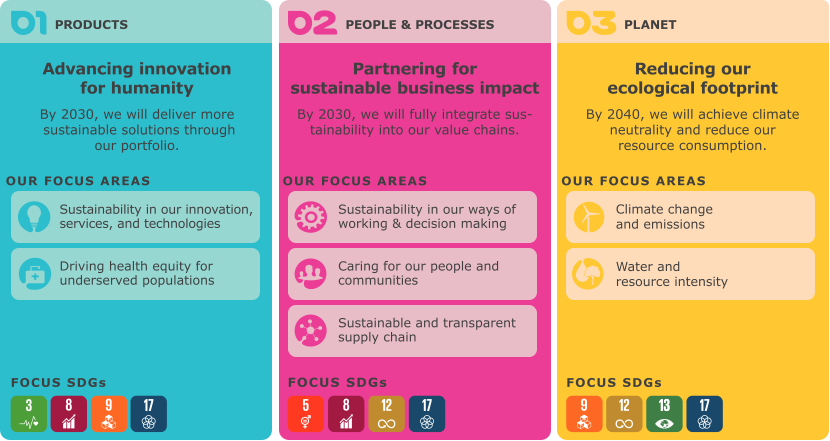
Overall, our sustainability strategy is centered on seven focus areas. Within these focus areas, we are currently realizing numerous initiatives and projects and plan to continue doing this in the future. We constantly review the relevance and applicability of these goals and focus areas and adjust them where necessary. Thus, in 2025, we revised our first goal and refined our ambition to provide more sustainable solutions through our portfolio. We measure our progress using a range of sustainability key indicators that we publish on our website (content of the website is not audited). We developed our key performance indicators in the financial year, including another key performance indicator for sustainability and transparency in the supply chain.
The following table shows the part of the sustainability key indicators that is mandatory for our ESRS reporting:
Strategic goal |
|
Value chain |
|
Sustainability key indicator |
|
2025 |
|
20243 |
|
More information |
||||||||||
|---|---|---|---|---|---|---|---|---|---|---|---|---|---|---|---|---|---|---|---|---|
1 |
|
Downstream |
|
Number of people treated with our Healthcare products (in million)1 |
|
182 |
|
184 |
|
|||||||||||
1 |
|
Own operations |
|
Reduction of number of animals used compared to 2021 (in %)2 |
|
25 |
|
|
|
|||||||||||
2 |
|
Own operations |
|
Environment, health and safety (EHS) incident rate |
|
1.85 |
|
2.23 |
|
|||||||||||
2 |
|
Own operations |
|
Lost time injury rate (LTIR) |
|
0.98 |
|
1.16 |
|
|||||||||||
2 |
|
Own operations |
|
Injury Count Rate (ICR)2 |
|
2.15 |
|
|
|
|||||||||||
2 |
|
Upstream |
|
Percentage of relevant suppliers (in terms of number) that are covered by a valid sustainability assessment1 |
|
73 |
|
75 |
|
|||||||||||
2 |
|
Upstream |
|
Percentage of relevant suppliers (in terms of spend) that are covered by a valid sustainability assessment1 |
|
96 |
|
94 |
|
|||||||||||
2 |
|
Upstream |
|
Share of procurement spend attributable to suppliers with a valid sustainability assessment of "good" or higher (in %)1 2 |
|
59 |
|
|
|
|||||||||||
2 |
|
Own operations |
|
Violations of Global Social and Labor Standards Policy |
|
60 |
|
57 |
|
|||||||||||
3 |
|
Own operations |
|
Greenhouse gas emissions Scope 1 and 2 (in metric tons)1 |
|
854,908 |
|
1,085,124 |
|
|||||||||||
3 |
|
Upstream; downstream |
|
Indirect greenhouse gas emissions (Scope 3 intensity: metric tons CO2eq per € million gross profit) |
|
316 |
|
359 |
|
|||||||||||
3 |
|
Upstream |
|
Percentage of purchased electricity from renewable sources (in %) |
|
63.9 |
|
52.2 |
|
|||||||||||
3 |
|
Own operations |
|
Circularity rate (in %) |
|
70.1 |
|
69.2 |
|
|||||||||||
3 |
|
Own operations |
|
Water efficiency (m3 per € million net sales)4 |
|
490 |
|
588 |
|
|||||||||||
|
||||||||||||||||||||
Generally, our sustainability strategy is implemented Group-wide. Specific activities are defined for our three business sectors with their different product and service portfolios. Unless stated otherwise, the sustainability key indicators apply globally. Where appropriate, we differentiate by geographical region or relationships with stakeholders. For example, this applies to our strategy in the Healthcare business sector, with which we aim to improve access to our products and services as well as medical information in low- and middle-income countries. The goals that we have defined in this context relate to the interests of our stakeholders, for example the end-users that benefit from our schistosomiasis elimination program in sub-Saharan Africa in particular.
Our Life Science business sector takes a holistic life cycle approach, embedding sustainability matters across the entire value chain: from the selection of raw materials and the supply chain to research and development, production, packaging, distribution, product use, and the end-of-life cycle and disposal. We do not only concentrate on the product life cycle but also work to improve global access to science and Science, Technology, Engineering and Mathematics (STEM) education. We support our customers on their own path toward sustainability through targeted actions such as our Design for Sustainability framework, our SMASH Packaging program or our EDISON program for energy and water efficiency. Through global collaboration with cross-functional teams, industry partners, suppliers, and customers, we act as a sustainability multiplier for the life science industry. Further information can be found under E1, E2, E3, and E5.
In our Healthcare business sector, we are working to improve medicinal provision for patients and harmonize our business activities with the environment while simultaneously driving long-term company growth. Throughout our value chain, we strive to develop medicines with a high health impact while also minimizing their environmental footprint. We advocate for global access to medicines, also in low- and middle-income countries, by investing in stronger health systems and anchoring health equity firmly in our business strategy. Through personalized health solutions and digital health technologies, we are creating a seamless, patient-centered supply offer. Collaboration is the key to this strategy: We maintain transparent partnerships with suppliers and contract manufacturing organizations and work actively with political decision-makers, governments, municipalities, academic institutions, and charitable organizations. Further information can be found under S4.
In our Electronics business sector, we are committed to shaping the digital transformation. We consider sustainability to be a core aspect of our technology roadmap and endeavor to address the critical industry challenges that lie ahead. We use data and digital tools to accelerate the development of new solutions, such as process gases with lower global warming potential or substitutes for substances of concern. As a major supplier to the electronics industry, we are committed to reducing the environmental impact of our business activities, focusing on GHG emissions, water consumption, energy use, and waste. Further information can be found under E1, E2, E3, and E5.
Details on our business model and our value chain can be found in our Management Report under Fundamental Information about the Group.