As we operate internationally and due to our presence in the capital markets, we are exposed to various financial risks and opportunities. Above all, these include liquidity and counterparty risks, financial market risks and opportunities, risks of fluctuations in the market values of operational tangible and intangible assets, as well as risks and opportunities from pension obligations.
In the area of financial risks and opportunities, we use an active management strategy to reduce the effects of fluctuations in exchange and interest rates. The management of financial risks and opportunities by using derivatives is regulated through extensive guidelines. Speculation is prohibited, and derivative transactions are subject to constant risk controls. The strict segregation of functions between trading, settlement and control is ensured.
Liquidity risks
To ensure continued existence, we must be able to fulfill our commitments arising from operating and financial activities at any time. Therefore, to reduce potential liquidity risks, we have a central Group-wide liquidity management system in place and a balanced maturity profile. The maturities of our financial liabilities are aligned with our planned free cash flow. Furthermore, we have a syndicated loan facility of € 2.5 billion with a term until 2029, which ensures continuing solvency if any liquidity bottlenecks occur. As our loan agreements do not contain any financial covenants, these agreed lines of credit can be accessed even if our credit rating should deteriorate. Additionally, we have a commercial paper program with a maximum volume of € 2.5 billion at our disposal. The occurrence of liquidity risk is assessed as highly improbable and with only immaterial impact.
Counterparty risks
Counterparty risks arise from the potential default by a partner in connection with financial investments, loans and financing commitments on the one hand as well as receivables in operating business on the other hand.
As for counterparty risks from financial transactions, we review all central positions relating to trading partners and their credit ratings daily. We manage financial risks of default by diversifying our financial positions and through the related active management of our trading partners. Significant financial transactions involving credit risk are entered into with banks and industrial companies that have a good credit rating. Moreover, our large banking syndicate – the loan facility of € 2.5 billion was syndicated among 15 banks – reduces possible losses in the event of default.
The solvency and operational development of trading partners are regularly reviewed as part of the management of operational counterparty risks. Sovereign risks are also analyzed. The volume of receivables of each customer is capped in line with their credit ratings. Risk-mitigating measures, such as credit insurance, are implemented, as appropriate. Nevertheless, defaults by isolated trading partners, even those with outstanding credit ratings, cannot be entirely ruled out.
Minor counterparty risks are classified as unlikely to likely and could have minor to moderate effects.
Financial market risks and opportunities
As a result of our international business activities, we are exposed to risks and opportunities from fluctuations in exchange rates. These result from financial transactions, operating receivables and liabilities as well as future cash flows from sales and expenses in foreign currency. We use derivatives to manage these risks and opportunities (further information can be found under Derivative Financial Instruments in the Notes to the Consolidated Financial Statements). Foreign exchange rate risks are rated as likely with a significant effect on EBITDA pre and free cash flow.
Variable interest and current financial liabilities are exposed to the risks and opportunities of interest rate fluctuations. Interest rate risks have a negative impact, are considered possible and pose a minor risk overall.
Risks of impairment of balance sheet items
The carrying amounts of individual balance sheet items are subject to the risk of changing market and business conditions and thus to changes in fair values as well. Necessary impairments could have a significant negative non-cash impact on earnings and affect the accounting ratios. This applies specifically to the high level of intangible assets including goodwill, which mainly derive from the purchase price allocations made in connection with past acquisitions (further information can be found under Goodwill and Other Intangible Assets in the Notes to the Consolidated Financial Statements). This possible qualitative risk could have a significant effect on reputation.
Risks and opportunities from pension obligations
We have commitments in connection with pension obligations. The present value of defined benefit obligations can be significantly increased or reduced by changes in the relevant valuation parameters, such as the interest rate or future salary increases. Pension obligations are assessed as part of annual actuarial reports. The obligations are covered by the pension provisions reported in the balance sheet based on the assumptions as of the balance sheet date. Some of these obligations are funded by plan assets (further information can be found under Provisions for Pensions and Other Post-Employment Benefits in the Notes to the Consolidated Financial Statements).
To the extent that pension obligations are covered by plan assets consisting of interest-bearing securities, shares, real estate, and other financial assets, decreasing or negative returns on these assets can adversely affect the fair value of plan assets and thus result in further additions to pension provisions. By contrast, rising returns increase the value of plan assets, thereby resulting in excess cover of plan liabilities. We increase the opportunities of fluctuations in the market value of plan assets on the one hand and reduce the risks by using a diversified investment strategy on the other hand. The possible risk due to pension obligations could have minor effects.
Risks due to the divestment, acquisition and integration of companies and businesses
The successful acquisition and integration of new businesses inherently involve risks, due primarily to the uncertainty of meeting business objectives and synergy targets as well as adhering to the planned integration budget (e.g. the integration of SpringWorks Therapeutics, Inc., USA, with its highly innovative product pipeline for the treatment of rare diseases). Conversely, divestments (e.g. the Surface Solutions business unit) may result in liabilities and additional expenses arising from potential indemnifications and commitments assured in the sale transaction or from separation costs exceeding expectations. We mitigate transaction-related risks by leveraging our robust track record, conducting rigorous due diligence and employing representations and warranties insurance in our merger and acquisition transactions. Furthermore, we ensure seamless integration through strategic planning and execution, facilitating the alignment of the acquired entities with our organizational goals. At present, only moderate negative impacts are likely.
Assessment by independent rating agencies
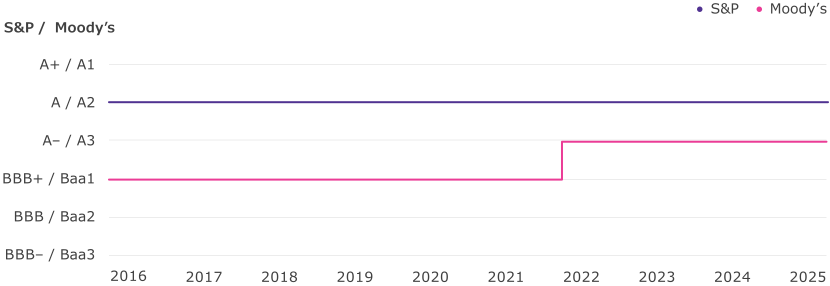
The capital market uses the assessments published by rating agencies to help lenders assess the risks of financial instruments used by us. We are currently rated by Standard & Poor’s and Moody’s. Standard & Poor’s has issued a long-term credit rating of A with a stable outlook and Moody’s has issued a rating of A3 with a stable outlook. In line with market procedures, our financing conditions are closely tied to our rating. The better the rating, the more favorably we can generally raise funds on the capital market or from banks.
Overview of rating development