
The performance-related and performance-independent components of the compensation system for the Executive Board in fiscal 2025 are fully consistent with the Executive Board compensation system approved by the Annual General Meeting 2021 with a voting result of 87.08%. The compensation system 2021 is published on our website and has applied to all members of the Executive Board since January 1, 2021. The new compensation system 2026, which was approved with 88.77% of the votes at the 2025 Annual General Meeting, will come into force with effect as of January 1, 2026. The Personnel Committee ensures compliance with the compensation system by deciding by resolution on its specific application (e.g. setting targets, determining target achievement, etc.) as well as on the amounts to be paid out.
The following section reports on the compensation awarded or due in accordance with section 162 (1) AktG. Accordingly, the following sections contain all amounts paid to individual members of the Executive Board (active and former members) in the fiscal year (compensation awarded) as well as all amounts legally due but not yet received (compensation due).
In addition, the compensation for which the members of the Executive Board have provided the underlying service in full by December 31, 2025, but for which payment will be made in the following year, is disclosed on a voluntary basis. This applies to the profit sharing for fiscal 2025, as well as to the LTI tranche 2022, the performance period of which ended on December 31, 2025. These amounts have been provisionally determined by the Personnel Committee by resolution. The final amount will be paid to the members of the Executive Board once the Consolidated Financial Statements of E. Merck KG, Darmstadt, Germany, have been released. This enables transparent information and ensures the link between performance and compensation in the financial year.
Performance-independent compensation
Base salary
As base salary, the members of the Executive Board receive contractually fixed performance-independent amounts that are paid in the form of 12 equal monthly installments.
Due to the appointment of Kai Beckmann as Deputy Chair of the Executive Board, his base salary was increased from € 1,200,000 to € 1,300,000, effective September 25, 2025.
Additional benefits
The additional benefits mainly include company cars for personal use, contributions to insurance policies and expenses for personal protection.
Compensation payments were agreed with Helene von Roeder to compensate for the loss of variable compensation claims from her previous position on the Management Board of Vonovia SE, which resulted from her move to the Executive Board of Merck KGaA, Darmstadt, Germany, on July 1, 2023. The loss of the claims was proven on the basis of appropriate supporting documents.
The compensation payment for the loss of the long-term variable compensation entitlement is based on the plan rules of Vonovia SE’s LTIP Tranche 2023, the performance period of which runs from the beginning of 2023 to the end of 2026. The amount can only be calculated after the publication of Vonovia SE’s 2026 annual financial statements and will be paid out in fiscal 2027. This procedure ensures that Helene von Roeder only receives the long-term variable compensation that has actually been lost. The details of this were published in the 2023 Compensation Report.
Pension entitlement
The members of the Executive Board are granted a pension obligation as a direct commitment. A fixed amount is paid into a benefit account every year, and interest is paid at the applicable statutory maximum technical interest rate for the life insurance industry in accordance with section 2 (1) of the German Regulation on the Principles Underlying the Calculation of the Premium Reserve (DeckRV). Once the pension event occurs, the retirement capital in the benefit account is paid out either in ten annual installments or as a one-time payment. The pension event occurs upon retirement, in the event of occupational disability, or death. In fiscal 2025, no pension contributions were increased. The following table shows the pension obligations which result from the pension entitlements of the members of the Executive Board.
|
|
|
|
IAS 19 |
||||||
|---|---|---|---|---|---|---|---|---|---|---|
|
|
|
|
Service cost |
|
Present value of the pension obligation as of December 31 |
||||
€ thousand |
|
Contribution level |
|
2025 |
|
2024 |
|
2025 |
|
2024 |
Belén Garijo |
|
650 |
|
642 |
|
640 |
|
9,645 |
|
8,710 |
Kai Beckmann |
|
450 |
|
435 |
|
435 |
|
8,146 |
|
7,478 |
Peter Guenter (until May 31, 2025) |
|
186 |
|
182 |
|
436 |
|
– |
|
1,835 |
Matthias Heinzel (until May 31, 2025) |
|
450 |
|
446 |
|
447 |
|
2,366 |
|
1,883 |
Helene von Roeder |
|
450 |
|
464 |
|
479 |
|
1,200 |
|
733 |
Total |
|
2,186 |
|
2,169 |
|
2,437 |
|
21,357 |
|
20,639 |
In accordance with the Executive Board compensation system 2021, a pension agreement was entered into with Khadija Ben Hammada, Jean-Charles Wirth and Dan Pinhas Bar Zohar. The individual contractual pension contribution amounts to € 450,000 annually in each case. In fiscal 2025, it was agreed with Khadija Ben Hammada, Jean-Charles Wirth and Dan Pinhas Bar Zohar to switch to the pension substitute from January 1, 2026 in accordance with the compensation system for the Executive Board 2026 as well as a compensation payment for the pension contribution 2025 based on the compensation system 2021. This compensation will be paid in January 2026.
Peter Guenter had a pension commitment until May 31, 2025. The retirement capital was paid upon retirement as a one-time payment.
Performance-related compensation
Performance-related compensation comprises profit sharing as well as the Long-Term Incentive Plan.
Profit sharing
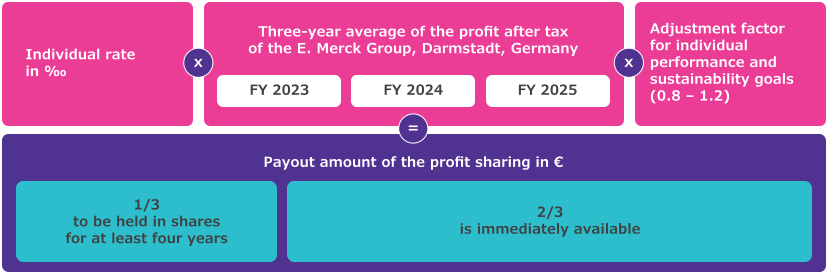
With regard to profit sharing, an individual profit-sharing rate is contractually defined for the members of the Executive Board as a per mille rate of the three-year average of the consolidated profit after tax of the Group of E. Merck KG, Darmstadt, Germany. Fiscal 2025 and the two preceding fiscal years are included in the calculation.
The use of profit after tax as the key performance indicator, which also serves as the basis for dividend payments, ensures very close alignment with shareholder interests.
To appropriately consider the individual performance of the Executive Board members, the Personnel Committee may modify the payment by applying a factor ranging from 0.8 to 1.2. The adjustment factor allows recognition of outstanding individual performance as well as overachievement of certain sustainability targets by multiplying the profit sharing by a value greater than 1.0 up to 1.2. Similarly, multiplying by a value less than 1.0 down to 0.8 can reduce the profit sharing if the circumstances call for it, such as a failure to achieve sustainability targets.
The members of the Executive Board are obligated to invest one-third of the payout of the profit sharing in our shares and to hold them for at least four years. The obligation to hold shares refers to the payout amount of the profit sharing. Further details are provided under the heading Share Ownership Guideline.
The following illustration shows the profit sharing for fiscal 2025:
The Group of E. Merck KG, Darmstadt, Germany, must generate an average profit after tax of at least € 0.75 billion for the profit-sharing payment to be made. This minimum threshold reflects the “pay-for-performance” approach of the compensation system. If the profit exceeds this threshold, the individual profit-sharing rates are staggered as illustrated below:
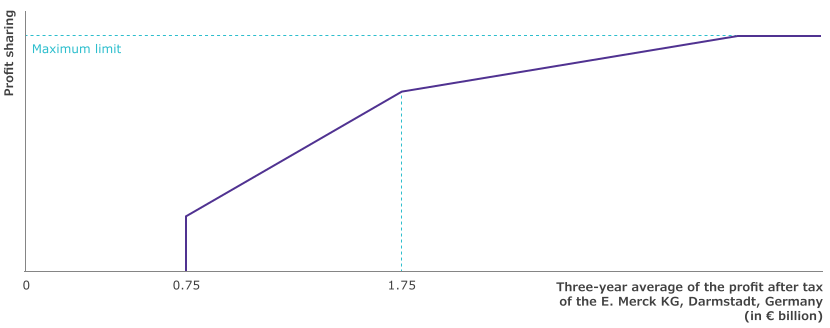
The maximum profit-sharing payment is capped individually. It amounts to € 4,810 thousand for Belén Garijo, € 3,900 thousand for Peter Guenter, Matthias Heinzel, Dan Pinhas Bar Zohar, and Jean-Charles Wirth and € 3,300 thousand for Helene von Roeder and Khadija Ben Hammada. Due to Kai Beckmann’s appointment as Deputy Chair of the Executive Board, effective September 25, 2025, the maximum profit-sharing payment for Kai Beckmann has been adjusted from € 3,500,000 to € 3,900,000. In the event of intra-year entries to or exits from the Executive Board, as well as intra-year compensation adjustments, the contractual provisions stipulate a pro-rata calculation of the respective maximum amounts.
The three-year average that is relevant for fiscal 2025 was based on the profit after tax generated by the Group of E. Merck KG, Darmstadt, Germany, in fiscal 2023, 2024 and 2025, as illustrated in the following table and graphic:
€ million |
|
2022 |
|
2023 |
|
2024 |
|
2025 |
|---|---|---|---|---|---|---|---|---|
Profit after tax |
|
3,288 |
|
2,760 |
|
2,696 |
|
2,530 |
Three-year average profit after tax |
|
2,915 |
|
|
||||
Three-year average profit after tax |
|
|
|
2,662 |
||||
€ million
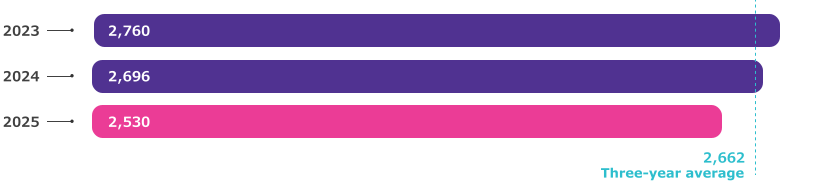
The Personnel Committee has set the adjustment factor at 1.0 for all members of the Executive Board, taking into account individual performance as well as contributions to sustainability goals against the agreed criteria.
The Personnel Committee thereby acknowledges that, due to the contributions and commitment of the Executive Board members, the growth trajectory has continued despite a persistently challenging macroeconomic environment. Via thoughtful decisions and strategic foresight, the three business sectors Life Science, Healthcare and Electronics have set the course for the company’s continued successful and resilient development in the future. In addition to economic successes, further achievements in relation to our three sustainability goals have been made under the leadership of the Executive Board.
The successes achieved are the result of close collaboration among the members of the Executive Board. Therefore, in the view of the Personnel Committee, a differentiation of the adjustment factor between the members of the Executive Board is not appropriate.
Considering the relevant three-year average of the profit after tax of the Group of E. Merck KG, Darmstadt, Germany, the individual sharing rates and the adjustment factor, the profit sharing and the shareholding obligation for fiscal 2025 are as follows:
|
|
Three-year average profit after tax (€ million) |
|
Average individual profit-sharing rate 2025 (in per mille)1 |
|
Adjustment factor for individual performance |
|
Profit-sharing amount (€ thousand) |
|
thereof investment obligation (€ thousand)2 |
||||||||
|---|---|---|---|---|---|---|---|---|---|---|---|---|---|---|---|---|---|---|
Belén Garijo |
|
2,662 |
|
1.63 |
|
1.0 |
|
4,338 |
|
1,446 |
||||||||
Kai Beckmann |
|
|
1.22 |
|
1.0 |
|
3,251 |
|
1,084 |
|||||||||
Peter Guenter |
|
|
0.55 |
|
1.0 |
|
1,452 |
|
484 |
|||||||||
Matthias Heinzel |
|
|
1.32 |
|
1.0 |
|
3,510 |
|
1,170 |
|||||||||
Helene von Roeder |
|
|
1.11 |
|
1.0 |
|
2,956 |
|
985 |
|||||||||
Khadija Ben Hammada |
|
|
0.93 |
|
1.0 |
|
2,478 |
|
826 |
|||||||||
Jean-Charles Wirth |
|
|
0.77 |
|
1.0 |
|
2,058 |
|
686 |
|||||||||
Dan Pinhas Bar Zohar |
|
|
0.77 |
|
1.0 |
|
2,058 |
|
686 |
|||||||||
|
||||||||||||||||||
The profit sharing 2025 will be paid out in April 2026. One-third of the payout of the profit sharing must be invested in shares of Merck KGaA, Darmstadt, Germany, and held for at least four years (investment obligation). Further details of the investment obligation can be found under Share Ownership Guideline.
In fiscal 2025, the profit sharing for fiscal 2024, already explained in detail in the Compensation Report 2024, was paid out, which is thus reported as compensation awarded or due in fiscal 2025 in accordance with section 162 AktG. Further details can be found in the following table from the previous year:
|
|
Three-year average profit after tax (€ million) |
|
Average individual profit-sharing rate 2024 (in per mille)1 |
|
Adjustment factor for individual performance |
|
Profit-sharing amount (€ thousand) |
|
thereof investment obligation (€ thousand)2 |
||||||
|---|---|---|---|---|---|---|---|---|---|---|---|---|---|---|---|---|
Belén Garijo |
|
2,915 |
|
1.55 |
|
1.0 |
|
4,515 |
|
1,505 |
||||||
Kai Beckmann |
|
|
1.13 |
|
1.0 |
|
3,282 |
|
1,094 |
|||||||
Peter Guenter |
|
|
1.25 |
|
1.0 |
|
3,654 |
|
1,218 |
|||||||
Matthias Heinzel |
|
|
1.25 |
|
1.0 |
|
3,654 |
|
1,218 |
|||||||
Helene von Roeder |
|
|
1.06 |
|
1.0 |
|
3,082 |
|
1,027 |
|||||||
|
||||||||||||||||
Long-Term Incentive Plan (LTIP)
LTIP tranche for fiscal 2025
The LTIP is designed as a virtual performance share plan. It is based on a four-year future-oriented performance cycle that is composed of a three-year target achievement cycle and a subsequent one-year holding period. In addition to three financial performance indicators, the LTIP takes sustainability targets into account. These targets are linked to a sustainability factor. The sustainability factor has a range of 0.8 to 1.2 and can increase or reduce the target achievement resulting from the financial key performance indicators by up to 20%. The following graphic illustrates the calculation of the Share Units of Merck KGaA, Darmstadt, Germany (MSUs), as well as the functionality of the sustainability factor.
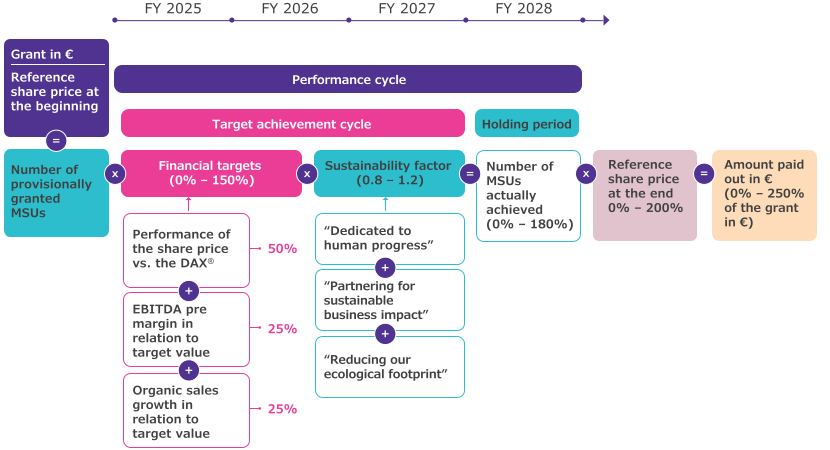
Calculation of the MSUs
Under the LTIP, members of the Executive Board are provisionally granted a certain number of virtual shares, so-called Share Units of Merck KGaA, Darmstadt, Germany (MSUs). The number of MSUs is calculated as follows: An individual grant in euros is set for each Executive Board member. Every year, this grant is divided by the definitive reference share price at the beginning of the performance cycle, resulting in the number of MSUs that the respective member is provisionally entitled to receive. The relevant reference share price is based on the average share price within the last 60 trading days prior to the start of the performance period.
In fiscal 2025, the LTIP tranche 2025 was allocated as follows:
|
|
Grant amount (€ thousand) |
|
Reference share price of Merck KGaA, Darmstadt, Germany, |
|
Number of provisionally granted MSUs |
|
Maximum payout (€ thousand) |
||||
|---|---|---|---|---|---|---|---|---|---|---|---|---|
Belén Garijo |
|
2,300 |
|
148.18 |
|
15,522 |
|
5,750 |
||||
Kai Beckmann |
|
1,765 |
|
|
11,909 |
|
4,412 |
|||||
Peter Guenter (until May 31, 2025)1 |
|
792 |
|
|
5,343 |
|
1,979 |
|||||
Matthias Heinzel (until May 31, 2025) |
|
1,900 |
|
|
12,823 |
|
4,750 |
|||||
Helene von Roeder |
|
1,400 |
|
|
9,448 |
|
3,500 |
|||||
Khadija Ben Hammada (since: March 1, 2025)1 |
|
1,167 |
|
|
7,874 |
|
2,917 |
|||||
Jean-Charles Wirth (since: June 1, 2025)1 |
|
1,108 |
|
|
7,480 |
|
2,771 |
|||||
Dan Pinhas Bar Zohar (since: June 1, 2025)1 |
|
1,108 |
|
|
7,480 |
|
2,771 |
|||||
|
||||||||||||
The number of MSUs actually allocated to the Executive Board members after the end of the target achievement cycle depends on the development of the financial performance indicators and the sustainability factor during the three-year target achievement cycle.
Based on the three financial performance indicators, the number of MSUs allocated may be between 0% and 150% of the provisionally granted MSUs. The resulting number of MSUs is then multiplied by the sustainability factor.
Sustainability factor target achievement can range between 0.8 and 1.2 and is determined by the predefined sustainability key indicators. Thus, the total number of MSUs actually allocated can amount to a maximum of 180% of the provisionally granted MSUs.
The target achievement cycle is followed by a one-year holding period. The final payout amount may be between 0% and a maximum of 250% of the amount initially granted and depends on the number of MSUs actually allocated and the reference share price at the end of the performance cycle.
Financial key performance indicators
The relevant financial key performance indicators are:
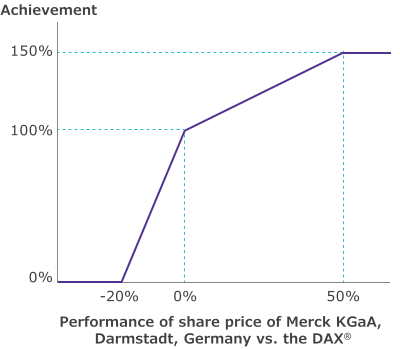
The performance of the share price of Merck KGaA, Darmstadt, Germany, compared with the performance of the DAX® with a weighting of 50%;
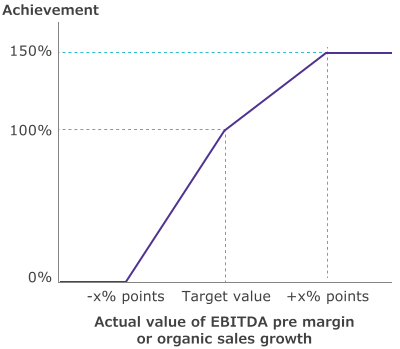
The EBITDA pre margin as a proportion of a defined target value with a weighting of 25%; and
The organic sales growth of the Group as a proportion of a predefined target value with a weighting of 25%.
The number of MSUs actually allocated after the end of the target achievement cycle is based on the following target achievement curves. The targets and thresholds for the key performance indicators of the EBITDA pre margin and organic sales growth are defined by the Personnel Committee at the beginning of the performance cycle and subsequently published in the Compensation Report.
Non-financial key indicators of the sustainability factor
With the introduction of the sustainability factor in fiscal 2022, our sustainability strategy is also incorporated into the LTIP. Based on the sustainability goals, the Personnel Committee defines corresponding specific and measurable sustainability key indicators as well as associated target and threshold values at the beginning of each tranche of the LTIP. These values are used to calculate target achievement at the end of the relevant target achievement cycle. The following sustainability criteria were defined for the selection of the sustainability key indicators:
Relevance and influence of the sustainability key indicators on the three overarching sustainability goals of the sustainability strategy;
Internal and external influence of the sustainability key indicators by management;
Good measurability and operationalization; and
Sustained impact to support long-term solutions.
In addition, the Personnel Committee determines the weighting of the individual sustainability goal for each tranche of the LTIP to emphasize priorities.
The Personnel Committee has defined the following sustainability key indicators and weightings for the 2025 tranche of the LTIP:
Sustainability Goal |
|
Weighting |
|
Sustainability Key Indicator |
||||
|---|---|---|---|---|---|---|---|---|
Dedicated to human progress1 |
|
30% |
|
People treated with our Healthcare products (including schistosomiasis control program) and pharma products enabled by our Life Science business sector |
||||
Partnering for sustainable business impact |
|
30% |
|
Share of procurement spend attributable to suppliers with a valid sustainability assessment of “good” or better |
||||
Reducing our ecological footprint |
|
40% |
|
Greenhouse gas emissions Scope 1+2 |
||||
|
||||||||
The following table shows the target corridors for the respective sustainability key indicators of the three overarching goals for the 2025 LTIP tranche ax ante.
Sustainability Goal/Key Indicator |
|
Minimum |
|
Target |
|
Maximum |
||||
|---|---|---|---|---|---|---|---|---|---|---|
Dedicated to human progress1 |
|
|
|
|
|
|
||||
Number of people treated with our Healthcare products (in million) |
|
581 |
|
623 |
|
664 |
||||
Number of people treated as part of the schistosomiasis control program (in million) |
|
|
|
|||||||
Number of people treated with pharma products enabled by our Life Science business sector (in million) |
|
|
|
|||||||
Partnering for sustainable business impact |
|
|
|
|
|
|
||||
Share of procurement spend attributable to suppliers with a valid sustainability assessment of “good” or better (percentage of procurement spend) |
|
51% |
|
61% |
|
67% |
||||
Reducing our ecological footprint |
|
|
|
|
|
|
||||
Greenhouse gas emissions in Scope 1+2 worldwide in kilotons (kt) |
|
800 |
|
730 |
|
660 |
||||
|
||||||||||
The key indicators selected within the three overarching sustainability goals can be described as follows:
“Dedicated to human progress”
We are convinced that with the help of science and technology, we can contribute to solving many global challenges. In this context, our Healthcare business sector measures how many people worldwide will be treated with our company’s medicinal products. On the one hand, we look at the number of people treated with products from the Healthcare business sector, and on the other hand, we consider patients who are offered treatment with our praziquantel tablets as part of the schistosomiasis control program.
We also include the number of people who are treated with pharmaceuticals and medicinal products for the production of which technologies and products from our Life Science business sector have made an important contribution. We plan to continuously increase the number of patients treated and thus contribute to a significant improvement in medical care and the state of health of as many people as possible.
At the end of 2025, we revised our sustainability goal “Dedicated to human progress” and strengthened our commitment to provide more sustainable solutions through our portfolio. In the course of this, the goal was modified to “Advancing Innovation for Humanity”. This change will be reflected in the LTIP from 2026.
“Partnering for sustainable business impact”
We measure our progress in embedding sustainability in our supply chains. In recent years, the focus has been on increasing the transparency of our supply chains and obtaining a sustainability assessment for more suppliers. Since we now have appropriate sustainability assessments for the majority of the relevant suppliers, we will focus on selecting more suppliers with a good sustainability profile from fiscal 2025 onward. In this context, it is important for us to increase the share of procurement expenditure with suppliers whose sustainability rating is “good” or better.
“Reducing our ecological footprint”
On our path to climate neutrality, we have already joined the Science Based Targets Initiative and aim to reduce both direct (Scope 1) and indirect emissions (Scope 2) by 50% by 2030 compared with fiscal 2020. This target is to be achieved by reducing process-related emissions, implementing energy efficiency measures and purchasing more electricity from renewable sources. Particularly in the case of process emissions (Scope 1), we aim to significantly reduce emissions by using new technologies.
The selected key indicators also reflect the topics that were classified as material in the CSRD materiality analysis and serve to achieve the goals of the sustainability strategy.
Target Achievement LTIP
When determining the target achievement for the tranche of the LTIP allocated in fiscal 2022, the sustainability factor introduced in fiscal 2022 was taken into account for the first time. The four-year performance period consisted of the target achievement cycle spanning three years (January 1, 2022 to December 31, 2024) and the subsequent one-year holding period (until December 31, 2025). At the end of the entire performance cycle of the LTIP 2022, the target achievement and the amounts were calculated based on the final share price. The relevant final share price is based on the average share price within 60 trading days prior to the end of the performance period. Subsequently, the amounts were multiplied by the sustainability factor and the final payout amounts were determined. The LTIP tranche 2022 will be paid out in April 2026.
The targets and thresholds, the actual amounts and the resulting target achievement for the LTIP tranche 2022 are as follows:
Financial key performance indicator |
|
Lower target corridor limit |
|
Target |
|
Upper target corridor limit |
|
Actual achieved value |
|
Target achievement |
|---|---|---|---|---|---|---|---|---|---|---|
Share price performance relative to the DAX® (weighting: 50%) |
|
-20.0% |
|
0.0% |
|
50.0% |
|
-54.9% |
|
0.0% |
EBITDA pre margin (weighting: 25%) |
|
27.2% |
|
30.2% |
|
33.2% |
|
29.2% |
|
66.7% |
Organic sales growth (weighting: 25%) |
|
4.9% |
|
7.9% |
|
10.9% |
|
2.3% |
|
0.0% |
Target achievement |
|
|
|
|
|
|
|
|
|
16.7% |
Sustainability goal/key indicator |
|
Lower target corridor limit |
|
Target |
|
Upper target corridor limit |
|
Actual achieved value |
|
Target achievement |
|---|---|---|---|---|---|---|---|---|---|---|
Dedicated to human progress |
|
|
|
|
|
|
|
|
|
|
People treated with our Healthcare products (millions) |
|
93.5 |
|
97.0 |
|
100.5 |
|
103.3 |
|
120% |
People treated as part of our schistosomiasis control program (millions) |
|
72.0 |
|
92.0 |
|
100.0 |
|
81.2 |
|
89% |
Partnering for sustainable business success |
|
|
|
|
|
|
|
|
|
|
Share of relevant suppliers covered by a valid sustainability assessment (percentage of total) |
|
60% |
|
70% |
|
80% |
|
75% |
|
110% |
Share of relevant suppliers covered by a valid sustainability assessment (percentage of procurement spend) |
|
80% |
|
90% |
|
100% |
|
94% |
|
108% |
Reducing our ecological footprint |
|
|
|
|
|
|
|
|
|
|
Scope 1 and 2 greenhouse gas emissions in metric kilotons (kt) |
|
1,200 |
|
1,000 |
|
800 |
|
1,085 |
|
92% |
Achievement of sustainability factor |
|
|
|
|
|
|
|
|
|
1.01 |
The resulting final number of MSUs and the payout amounts of the LTIP tranche 2022 are shown in the following table.
|
|
Grant amount (€ thousand) |
|
Reference share price of Merck KGaA, Darmstadt, Germany, |
|
Number of provisionally granted MSUs |
|
Total target achievement |
|
Sustainability factor |
|
Final number of MSUs |
|
Reference share price of Merck KGaA, Darmstadt, Germany, |
|
Payout amount (€ thousand)1 |
|---|---|---|---|---|---|---|---|---|---|---|---|---|---|---|---|---|
Belén Garijo |
|
2,300 |
|
212.16 |
|
10,841 |
|
16.7% |
|
1.01 |
|
1,826 |
|
116.08 |
|
212 |
Kai Beckmann |
|
1,715 |
|
|
8,084 |
|
|
|
1,361 |
|
|
158 |
||||
Peter Guenter |
|
1,900 |
|
|
8,956 |
|
|
|
1,508 |
|
|
175 |
||||
Matthias Heinzel |
|
1,900 |
|
|
8,956 |
|
|
|
1,508 |
|
|
175 |
||||
Marcus Kuhnert |
|
1,400 |
|
|
6,599 |
|
|
|
1,111 |
|
|
129 |
The LTIP tranche 2021 that was allocated in fiscal 2021 was structured without the sustainability factor introduced in fiscal 2022. The four-year performance period consisted of the target achievement cycle of three years (January 1, 2021 to December 31, 2023) and the subsequent one-year holding period (until December 31, 2024). At the end of the entire performance cycle of the LTIP 2021, the target achievement and the payout amounts were calculated based on the final share price. The relevant final share price is based on the average share price within 60 trading days prior to the end of the performance period. The LTIP tranche 2021 was paid out in April 2025.
The targets and thresholds, the actual amounts and the resulting target achievement for the LTIP tranche 2021 are as follows:
|
|
Lower target corridor limit |
|
Target |
|
Upper target corridor limit |
|
Actual achieved value |
|
Target achievement |
|---|---|---|---|---|---|---|---|---|---|---|
Share price performance relative to the DAX® (weighting: 50%) |
|
-20.0% |
|
0.0% |
|
50.0% |
|
-8.6% |
|
57.0% |
EBITDA pre margin (weighting: 25%) |
|
24.9% |
|
27.9% |
|
30.9% |
|
29.9% |
|
133.4% |
Organic sales growth (weighting: 25%) |
|
5.7% |
|
8.7% |
|
11.7% |
|
6.2% |
|
16.8% |
Total target achievement |
|
|
|
|
|
|
|
|
|
66.1% |
The resulting final number of MSUs and the payout amounts of the LTIP tranche 2021 are shown in the following table.
|
|
Grant amount (€ thousand) |
|
Reference share price of Merck KGaA, Darmstadt, Germany, |
|
Number of provisionally granted MSUs |
|
Total target achievement |
|
Final number of MSUs |
|
Reference share price of Merck KGaA, Darmstadt, Germany, |
|
Payout amount (€ thousand)1 |
|---|---|---|---|---|---|---|---|---|---|---|---|---|---|---|
Belén Garijo |
|
2,190 |
|
132.43 |
|
16,538 |
|
66.1% |
|
10,932 |
|
148.18 |
|
1,619 |
Kai Beckmann |
|
1,715 |
|
|
12,951 |
|
|
8,554 |
|
|
1,268 |
|||
Peter Guenter |
|
1,900 |
|
|
14,348 |
|
|
9,484 |
|
|
1,404 |
|||
Matthias Heinzel |
|
1,425 |
|
|
10,761 |
|
|
7,108 |
|
|
1,053 |
|||
Marcus Kuhnert |
|
1,400 |
|
|
10,572 |
|
|
6,988 |
|
|
1,035 |
|||
Stefan Oschmann |
|
752 |
|
|
5,676 |
|
|
3,752 |
|
|
556 |
Share Ownership Guideline
Under the Share Ownership Guideline (SOG), the members of the Executive Board are obliged to invest one-third of the payout of the profit sharing in our shares and to hold them for at least four years (investment obligation). The corresponding investments are made as part of an automated purchase via an external provider. Accordingly, 2,341 shares were purchased for Belén Garijo, 4,507 shares for Peter Guenter and Matthias Heinzel each, and 1,401 shares for Helene von Roeder in fiscal 2025, at a price of € 130.61 per share. In total, the number of shares to be held and blocked in the context of SOG in fiscal year 2025 amounts to 18,145 shares for Belén Garijo, 13,359 shares for Kai Beckmann, 14,155 shares for Matthias Heinzel, 14,859 shares for Peter Guenter, 5,481 shares for Helene von Roeder and 10,914 shares for Marcus Kuhnert. All members of the Executive Board fulfilled the investment and holding obligation in fiscal 2025.
The Share Ownership Guideline promotes an even stronger alignment of the interests of the members of the Executive Board with the sustainable interests of our shareholders and additionally increases the corporate responsibility of the members of the Executive Board in addition to their status as general partners.
Malus and clawback provisions
Through their status as personally liable general partners of Merck KGaA, Darmstadt, Germany, and E. Merck KG, Darmstadt, Germany, the Executive Board members bear a unique entrepreneurial responsibility. This is also reflected by the malus criteria set forth in the adjustment factor of the profit sharing and by the German statutory regulations on liability for damages stipulated in section 93 of the German Stock Corporation Act (AktG). In order to take even greater account of the prominent position of entrepreneurial responsibility in compensation, a clawback provision is implemented for the LTIP. Cases in which the clawback provision may be applied include violations of internal rules and regulations (Code of Conduct), legislation, other binding external requirements in responsibility, significant breaches of duty of care within the meaning of section 93 AktG, and other grossly non-compliant or unethical behavior or actions that are contradictory to our company values. In these cases, amounts that have already been allocated under the LTIP may be retained. The Personnel Committee is entitled to demand the repayment of profit sharing and LTIP payouts from a member of the Executive Board either in full or in part if it subsequently transpires that the payout was made wrongfully. For example, this is the case when targets are not actually met or are not met to the extent assumed when the payout was calculated due to incorrect information being applied. The extent of these claims for restitution is based on section 818 of the German Civil Code (BGB). The Personnel Committee may agree deadlines for the assertion of claims for restitution with the members of the Executive Board.
Neither the malus provision nor the clawback provision was exercised in fiscal 2025.
Compensation-related transactions
Contracts with the members of the Executive Board are usually entered into for a period of five years. If a contract begins during the year, the fixed compensation, profit sharing and individual LTIP tranches are paid on a pro rata basis.
Should members of the Executive Board be held liable for financial losses while executing their duties, this liability risk is covered by a directors and officers insurance policy under certain circumstances. This insurance policy has a deductible in accordance with the legal requirements.
Obligations in connection with the termination of Executive Board membership
The contracts of the Executive Board members do not provide for ordinary termination. The right to extraordinary termination for good cause in accordance with section 626 BGB is available to both parties without observing a notice period.
The contracts of the Executive Board members provide for the continued payment of fixed compensation to surviving dependents for a limited period in the event of death. Above and beyond existing pension obligations, no further obligations are provided for in the event of the termination of the contractual relationships of the Executive Board members.
The amounts payable to Executive Board members are capped in the event of the early termination of the contract without good cause justifying such termination. Pursuant to this, payments in connection with the termination of an Executive Board member’s duties shall not exceed twice the annual total compensation or constitute compensation for more than the remaining term of the employment contract (severance cap). If an Executive Board member’s membership terminates due to the termination of the contract either by the company or the Executive Board member before the four-year performance cycle of an open LTIP tranche expires, the obligations resulting from the LTIP shall continue if there are specific reasons for the termination, such as non-renewal of the contract after it expires, or if the Board of Partners determines this to be appropriate at its own discretion; otherwise, the obligations shall expire.
Should obligations resulting from the LTIP continue to apply, any early severance payout is excluded. Likewise, no early payout or severance for the profit-sharing payment is granted. If the compensation in the fiscal year in which the Executive Board member’s duties cease is expected to be significantly higher or lower than in the previous fiscal year, the Board of Partners may decide to adjust the amount applied as the member’s total compensation at its own discretion.
In fiscal 2025, a termination agreement was reached with Peter Guenter on his early exit from the Executive Board and the termination of the contractual relationship with E. Merck KG, Darmstadt, Germany, with effect from May 31, 2025. It was agreed that the profit sharing for the year 2025 will be paid on a pro rata temporis basis at the contractually agreed due date. According to the Share Ownership Guideline, one-third of the payout amount of the profit sharing will be invested in shares and held for a further four years. His claims under the LTIP tranches for the years 2022, 2023, 2024, and 2025 shall remain valid after his retirement, provided that the obligations under the agreed post-contractual non-competition clause for the period from June 1, 2025 to December 31, 2026 are complied with. In addition, Peter Guenter received a severance payment of € 3,939,755. With regard to pensions, it was agreed with Peter Guenter that the pension agreement concluded between the parties will be terminated with effect from May 31, 2025. The pension contribution for the year 2025 was paid on a pro rata temporis basis up to that date. The retirement capital of € 2,088,566 set out in the pension agreement was paid out to Peter Guenter in 2025.
It has been agreed with Matthias Heinzel to leave the Executive Board as of May 31, 2025 and to terminate the contractual relationship with E. Merck KG, Darmstadt, Germany, with effect from December 31, 2025. The contract was suspended until December 31, 2025. Until December 31, 2025, Matthias Heinzel received his fixed monthly remuneration of € 100,000. The profit sharing for 2025 will be paid out to Matthias Heinzel in April 2026, and the required investment will be made in accordance with the SOG. For the period between July 1, 2025 and December 31, 2025 the adjustment factor was set to 1.0 per contractual agreement. The claims for LTIP payments from the current tranches will be met in full, provided that Matthias Heinzel complies with the obligation under the post-contractual non-competition clause for the period from January 1, 2026 to December 31, 2027. Matthias Heinzel was credited a full pension contribution for the year 2025 with effect until December 31, 2025. Matthias Heinzel also received the contractually defined additional benefits up to December 31, 2025. As compensation for the premature termination of his membership of the Executive Board, Matthias Heinzel received a severance payment of € 1,688,467.
Post-contractual non-competition clause
Post-contractual non-competition clauses have been agreed with the members of the Executive Board. In general, the post-contractual non-competition clause involves the payment of a waiting allowance amounting to 50% of the member’s average contractual benefits within the last twelve months and is paid for a period of two years. Other earnings and any severance payments are to be offset against this amount.
Peter Guenter is subject to a post-contractual non-competition clause for the period from June 1, 2025 to December 31, 2026. For the period from June 1, 2025 to December 31, 2025, the waiting allowance is not applicable because the severance payment has been credited. Peter Guenter will then receive a monthly waiting allowance of € 281,411 until December 31, 2026.
Matthias Heinzel is subject to a contractual non-competition clause until December 31, 2025, and a post-contractual non-competition clause for the period from January 1, 2026 to December 31, 2027. For the period from January 1, 2026 to March 31, 2026, the waiting allowance is not applicable, as a severance payment has been made for this period. From April 1, 2026 until December 31, 2027, Matthias Heinzel is entitled to a monthly waiting allowance of € 281,411.
Loans, advances, payments by affiliates of the Group
Neither loans nor advances were paid to members of the Executive Board during fiscal 2025, nor any payments by affiliated companies.