
In 2025, we once again performed a double materiality analysis to determine our material topics. We refined the current process and used an ESG data analysis tool to identify relevant IROs, describe new IROs and combine or clarify existing IROs where necessary. The process of the double materiality analysis occurred according to the following detailed steps.
Step 1 – List of sustainability topics and identification of IROs
The sustainability matters according to ESRS 1 AR 16 and the results of the materiality analysis of the previous year served as a basis for creating a list of relevant sustainability topics. We critically examined whether additional sustainability matters could be relevant for us, both from a company-specific and from a stakeholder perspective, and whether changes may have ensued regarding relevance and completeness. The list of topics formed the starting point for identifying IROs. We reviewed our business activities, among other things, with regard to IROs in connection with pollution, water and marine resources, the use of resources, and circular economy. We followed an open-ended approach throughout the process. Where necessary, we included new insights contributed by internal subject matter experts or external stakeholders in all steps of the approach and took them into account when assessing the listed topics. In general, material risks and opportunities occur as a result of impacts, dependencies or other factors. Examples of this include exposure to climate hazards or regulatory changes that relate to systemic risks. Physical and transitional risks were also taken into account. Among other things, we used our risk report and the TCFD risk report as sources.
Step 2 – Mapping the value chain
In this analytical step, we took our entire value chain into consideration, from our own operations to our upstream and downstream value chain. Due to the differing business models of our business sectors, we determined the value chain separately for each sector. Based on this, we identified the business activities and the associated industries. We then determined the underlying ESRS sectors and industries by consulting the ESRS-SEC 1 standard on sector classification. As far as possible, we also indicated dependencies on countries, geographical regions and sites as regards pollution, for example. Potential significant changes to the value chain were reviewed. These included, for example, the divestment of the Surface Solutions business unit and the acquisition of Springworks in fiscal 2025.
Step 3 – Listing and involving relevant stakeholders
We identified internal and external stakeholders and divided them into two groups depending on their integration in the overall assessment process of the materiality analysis: Internal experts from Group functions, such as Procurement, Human Resources and Finance (including Risk Management, Financial Reporting and Controlling) and specialists from the three business sectors were involved in the detailed identification, validation and assessment of IROs in their respective specialist area. Further external and internal stakeholders were involved in validating the results via questionnaires. We considered nature to be a silent stakeholder in the IRO assessment of relevant topics such as biodiversity. No direct consultations with affected communities took place during the process.
Step 4 – Assessing the impacts
As described in step 3, the identified IROs were evaluated by internal experts in their respective specialist area based on coordinated quantified assessment criteria and qualitative insights along the value chain. We selected a gross approach when identifying and assessing the IROs, meaning that no remedial actions were taken into consideration.
The assessment of the impacts was carried out based on an evaluation sheet in which all assessment criteria specified in the ESRS were applied. According to this, negative impacts occur if the company has caused damage to society and/or the environment through its direct or indirect business activities. We consider positive impacts to be activities that go far beyond compliance with legislation and create clear added value for the environment and/or society. For the assessment we considered whether the impact is actual or potential and evaluated the severity based on scale and scope, as well as the likelihood of potential impacts. For negative impacts, we also considered the irreversibility of the effects. Moreover, our assessment of the impacts took human rights aspects and the strategic relevance of the sub-topic into account.
We performed the assessment along the entire value chain for all our business sectors. In doing so, we considered our product and service portfolio, our assets, our diverse business relationships, and our geographical location. To determine which sustainability matters are material for reporting, we defined a threshold and assessed every actual and every potential impact that was identified. Impacts rated as significant or critical were considered material for reporting purposes.
Step 5 – Assessing risks and opportunities
The assessment of risks and opportunities for determining financial materiality also followed predefined approaches for quantitative and qualitative assessments. We performed them for our entire value chain.
We evaluated the risks and opportunities as per the ESRS requirements according to their likelihood and the potential extent of the financial effects that they would cause. We assessed the magnitude of a risk or opportunity and the associated implications for EBITDA pre and/or operating cash flow based on five categories: not material, minor, moderate, significant, or critical. Accordingly, risks classified as significant or critical in terms of their magnitude each have an impact on EBITDA pre and/or operating cash flow above € 100 million. We determined the likelihood of risks by classifying them as highly improbable, improbable, possible, likely, or more likely than not. The total financial impact was calculated by multiplying the magnitude by the likelihood. We aligned the assessment criteria with our risk management and took its risk matrix into account. We determined the threshold for financial materiality for all sustainability matters with risks and opportunities classified as significant or critical.
The results of the financial materiality assessment were validated by internal and external stakeholders.
According to our company’s risk management, all business sectors are obliged to ensure an adequate level of local risk management. This comprises regular and continuous efforts to identify, assess, monitor, and control local risks. The business sectors are required to analyze risks in an aggregated manner to enable a realistic overview of our overall risk profile. Our opportunities are identified as part of the strategy development or forecasting processes. We then evaluate the potential, taking opportunities and risks into account and using scenarios to obtain a holistic view of possible developments.
Step 6 – Subsequent review and approval
Finally, we validated the results of the double materiality analysis. To this end, results went through various quality controls, such as review and validation by the management of the business sectors, before they were ultimately approved by the MSC.
We review the results of our materiality analysis annually; the next review is scheduled for the first half of 2026.
Our process to identify and assess climate-related impacts, risks and opportunities
Our approach to identifying and evaluating climate-related impacts, risks and opportunities comprises several key steps. We define short‑term (to 2030), medium‑term (to 2040) and long‑term (to 2050) time horizons, and quantify them using scenario‑based financial and risk models. We used a Climate Risk and Opportunity Assessment (CROA) methodology and external models to quantify physical as well as transition risks and opportunities across various time horizons. The assessment considers the upstream value chain and our own operations.
Step 1: Identification of critical sites and GHG inventory analysis
We shortlisted the sites most significant to our global operations, also considering their total insured value. Using our internal GHG inventory analysis, we evaluated emissions across our business to better understand their sources and magnitude.
Step 2: Identification of physical and transition risks, and opportunities
Climate risks and opportunities refer to potential financial impacts stemming from climate change, categorized as follows:
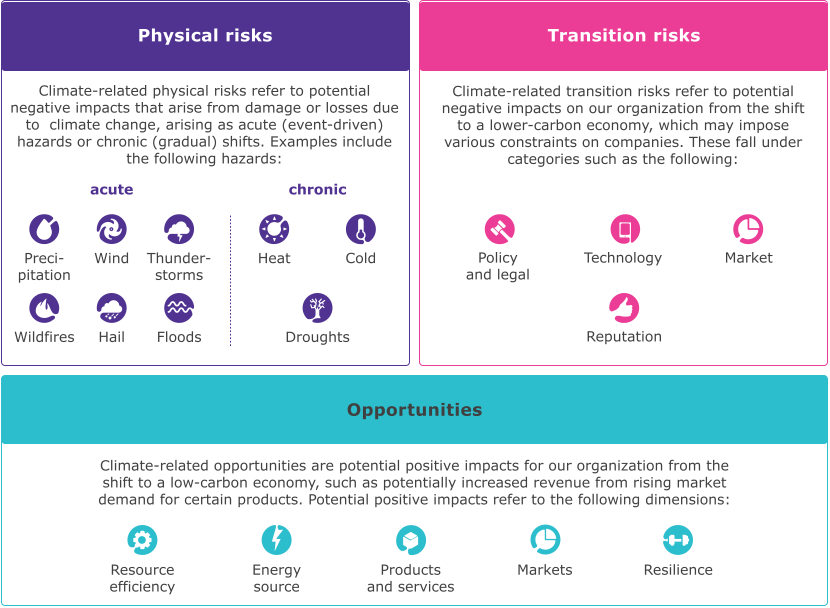
Step 3: Assessment of physical and transition risks and opportunities
Physical hazards are linked to the expected lifetime of assets, strategic planning and capital allocation. Our identification of climate-related hazards and the assessment of exposure and sensitivity were informed by high-emission climate scenarios and relevant regional climate projections. This process involved detailed analysis using climate models to evaluate the potential frequency and severity of hazards. We conducted a systematic assessment of the exposure and sensitivity of our assets and business activities by evaluating geographic, operational and temporal factors. The scenarios used are subject to limitations, notably data availability and spatial granularity, modeling and scenario‑assumption uncertainties, and necessary simplifying assumptions, so results should be treated as directional and refined as better data and models become available. This structured approach enabled us to determine whether our assets and business activities may be exposed to potential hazards, considering their likelihood, magnitude and duration. Our analysis of physical climaterelated risks was based on geospatial coordinates specific to our locations, allowing for a detailed assessment of vulnerabilities.
We identified and quantified the assets at risk, including buildings, infrastructure, inventory and other physical or financial assets that could be affected by climate events. We then assessed the vulnerability of exposed assets to understand how different asset types respond to hazards and estimated their susceptibility to damage or loss. To further understand potential impacts, we simulated climate-related events by combining hazard characteristics, such as intensity and duration, with the specific vulnerability of our assets to estimate possible losses. Based on these simulations, we calculated the expected costs, considering property damage, business interruption, liability claims and other relevant factors.
We implemented a comprehensive process to identify and quantify climate-related transition risks and opportunities within our operations and value chain. We identified potential transition drivers, such as increased taxes on Scope 1 GHG emissions, substituting existing products with lower-emission alternatives, changing customer behavior, and shifts in consumer preferences. This identification spanned short-, medium- and long-term time horizons. Our identification of transition drivers and the assessment of exposure were informed by a climate-related scenario analysis. We utilized three different scenarios: A 1.5°C Paris Agreement-aligned scenario, a 2.7°C middle-of-the-road scenario, and a 4.0°C fossil-fueled development scenario. Our scenario analysis considered several critical forces and drivers impacting our operations and strategic planning. These included (but were not limited to) policy assumptions, which involve analyzing potential impacts of regulatory frameworks and climate policies that may emerge in response to climate change; macroeconomic trends, which consider broader economic factors such as GDP growth, changes in consumer spending patterns that influence market demand, or changes in energy consumption patterns toward renewables. Furthermore, we recognize the potential impact of transition risks on our financial statements and overall asset vulnerability as we adapt to a changing regulatory and market landscape.
We then evaluated how our activities and financials may be exposed to these variables, with related quantifications of gross transition risks or opportunities. We analyzed historical data, scientific research and expert opinions to determine the likelihood and characteristics of potential catastrophic events in specific areas. For relevant risks, we evaluated their potential impacts, both with and without mitigation actions, such as considering strategic investments in renewable energy and enhancing energy efficiency.